



Three terms, three completely different processes — and using the wrong one is the fastest way to get a document rejected and lose weeks waiting to start over. Here is the fact that resolves most of the confusion immediately: the UAE is not a member of the Hague Apostille Convention, so a standalone apostille from another country is never accepted on its own for use in the UAE. If you remember nothing else from this guide, remember that.
Below, we break down exactly what a notary public, attestation, and apostille each mean, when you need which one, and how the process actually works in Abu Dhabi in 2026.
What Is a Notary Public?
A notary public in Abu Dhabi is a person or office licensed under ADJD Law No. 11 of 2017 by the Abu Dhabi Judicial Department to certify signatures, authenticate documents, and give them legal and executive force within the UAE. It is a local, in-country act — not a cross-border process.
In practice, a notary witnesses signatures, certifies true copies, and notarizes contracts, memoranda of association, and powers of attorney so they are legally enforceable in the UAE. This can be done through a private notary (an ADJD-licensed lawyer or firm) or a governmental notary office, including the English Language Notary Services Bureau. For the full breakdown of what each route involves and which documents qualify, see our notary public services in Abu Dhabi page.
What Is Attestation?
Attestation is the multi-step chain that verifies a document issued in another country is genuine, so UAE authorities will accept it. Unlike notarization, attestation is a cross-border process that typically involves four stages before a foreign document is usable in the UAE.
- Notarization in the country of origin
- Home-country foreign ministry authentication
- UAE Embassy or Consulate attestation, in the country of origin
- MOFA attestation inside the UAE — the final step, required before the document can be used

Miss any one of these four links and the document is generally rejected at the final step, which is why we always recommend a full document review before you start the chain.
What Is an Apostille — and Why the UAE Doesn't Accept It Alone
An apostille is a single-step certificate issued under the 1961 Hague Convention, valid only between member countries. Because the UAE never joined this convention, a document apostilled for use in a Hague country is not automatically valid in the UAE. It must instead go through the full attestation and legalization chain described above — or, in some cases, both an apostille (for use elsewhere) and full attestation (for use in the UAE).
One source of confusion: some countries' foreign ministry websites use the words "apostille" and "attestation" interchangeably in translation. This does not change the UAE requirement. Tasreea checks the specific requirement for your document and country of origin before you spend time or money on the wrong process.
Notary vs Attestation vs Apostille — Side-by-Side Comparison
| Notary Public | Attestation | Apostille | |
|---|---|---|---|
| What it does | Certifies a document or signature locally | Verifies a foreign document through a chain of authorities | Single-step certificate for Hague member countries |
| Where it applies | Inside the UAE (or country of document origin) | Cross-border, into the UAE | Between Hague Convention countries only |
| Accepted alone in UAE? | Yes, for UAE-issued documents | Yes, required for foreign documents | No — UAE is not a Hague member |
| Issued by | ADJD (private or governmental notary) | UAE Embassy + UAE MOFA (plus home country steps) | Designated authority in country of origin |
| Typical use case | Local contracts, POA, MOA | Foreign degree, marriage/birth certificate, POA from abroad | Documents moving between Hague member states (not for UAE) |
Which One Do You Need? (Decision Guide)
The deciding factor is where the document was issued, not what type of document it is. Use this quick guide to find your route:
- Document issued in the UAE, for use in the UAE → Notary Public only
- Document issued in the UAE, for use abroad → Notary + MOFA attestation (and possibly the destination country's embassy)
- Document issued abroad, for use in the UAE → Full attestation chain ending in MOFA — never just an apostille, even from a Hague country
- Document issued abroad, for use in a third Hague country → An apostille may be sufficient (this is not a UAE scenario)
Common Documents and Which Process They Need
Here is how this plays out for the documents we handle most often for clients in Abu Dhabi:
- Power of Attorney from abroad → Full attestation chain + MOFA
- Degree and education certificates → Full attestation chain + MOFA
- Marriage and birth certificates → Full attestation chain + MOFA
- Contracts of establishment / MOA issued in the UAE → Notary Public, plus company formation filing where relevant
- Commercial license assignment and sale → Notary Public
- Liquidation minutes → Notary Public
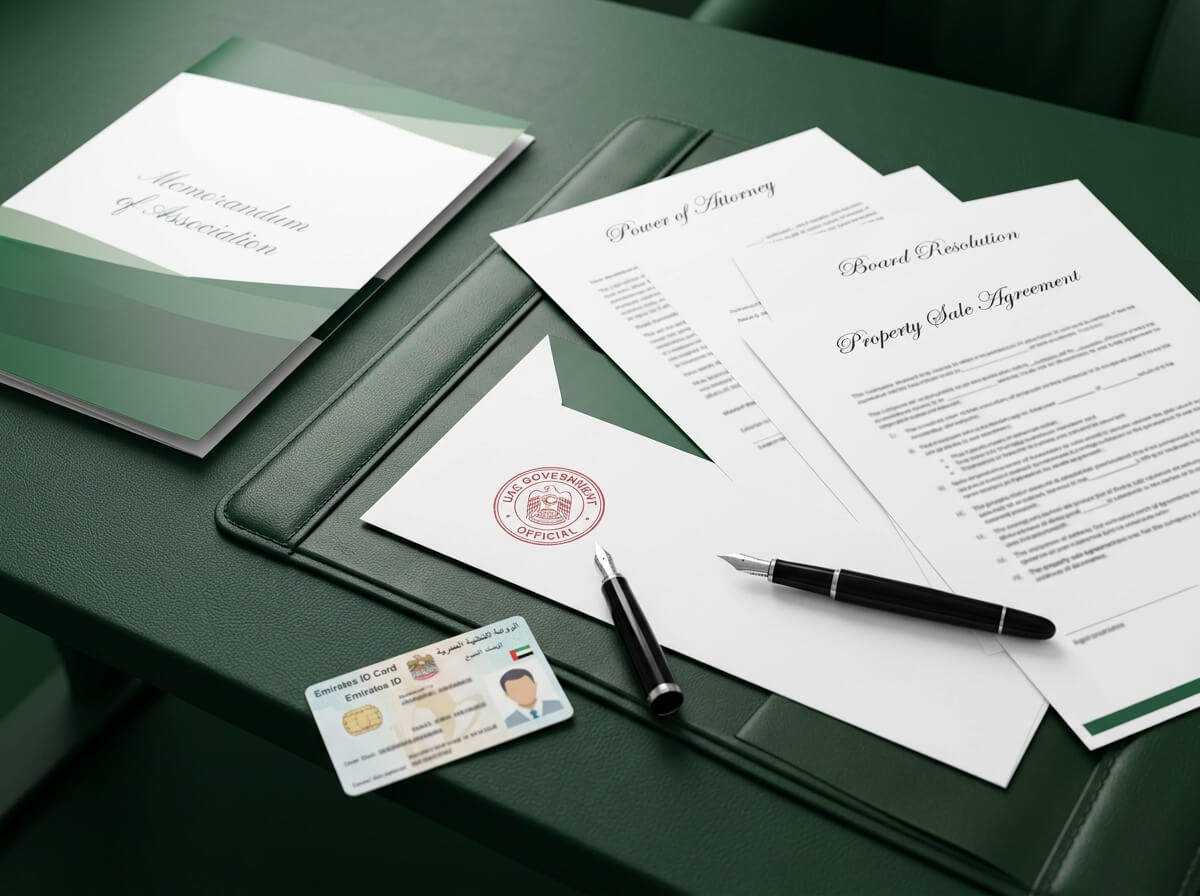
If your document package is part of a Golden Visa application, note that attestation is very often required for supporting documents such as degree certificates and marriage certificates before submission.
How Much Does It Cost and How Long Does It Take?
Costs and timelines vary by document, country of origin, and route chosen. As general ranges only:
- Notary Public in Abu Dhabi: typically same-day to a few business days
- MOFA attestation: a modest per-document government fee — confirm the current rate before you proceed
- Full foreign attestation chain: varies significantly by country of origin — generally days to a few weeks depending on your home country's process
We do not publish fixed pricing here because government fees and embassy charges change and differ by country. Contact us for a transparent quote based on your specific document and country of origin.
Common Mistakes That Get Documents Rejected
- Assuming an apostille alone will work for UAE use
- Skipping the home-country embassy attestation step
- Submitting documents without the required Arabic translation
- Using an expired or damaged original document
- Missing one link in the attestation chain — the single most common cause of rejection
Not Sure Which Process Your Document Needs?
Tasreea reviews your document for free and tells you exactly which route to take — notary, attestation, or both. We prepare and submit on your behalf, and coordinate every appointment so nothing gets missed.
Explore Notary Public Services →Frequently Asked Questions
Is an apostille valid in the UAE?
No, not on its own. The UAE never joined the 1961 Hague Apostille Convention, so a standalone apostille issued in another country is not accepted by UAE authorities. Documents from Hague member countries must still go through the full embassy and MOFA attestation chain before they can be used in the UAE.
What is the difference between attestation and legalization?
In practice, the UAE uses these terms interchangeably to describe the same multi-step process: verifying a foreign-issued document through the home country's foreign ministry, the UAE Embassy abroad, and finally the UAE Ministry of Foreign Affairs (MOFA) once the document reaches the UAE.
Do I need MOFA attestation if my document is already notarized?
It depends on where the document will be used. A document notarized in the UAE for use within the UAE usually needs nothing further. A document notarized abroad, or a UAE document intended for use in another country, typically still needs MOFA attestation (and sometimes the destination embassy) before it is accepted.
Can Tasreea attest my documents directly?
No. Tasreea is a business setup consultancy, not a government attestation authority. We review your documents, tell you exactly which process applies, prepare the paperwork, and coordinate appointments on your behalf. The actual notarization or attestation is always performed by ADJD, MOFA, or the relevant embassy.
How long does MOFA attestation take in Abu Dhabi?
Once a document has completed the required prior steps (home country and embassy attestation, where applicable), MOFA attestation inside the UAE is typically fast — often same-day to a few business days. The overall timeline depends far more on how quickly the earlier steps in the chain are completed.
Does my degree certificate need attestation to work in the UAE?
Yes, in most cases. Foreign education certificates generally need to be attested in the country of issue, at the UAE Embassy there, and then at MOFA in the UAE before employers, the Ministry of Education, or immigration authorities will accept them.
What happens if I use the wrong process for my document?
The document is rejected by whichever authority you submit it to — a bank, DED, immigration, or an employer — and you have to restart from the missing step. This is the single most common cause of delays we see, which is why we recommend a free document review before you begin.
Is a UAE-issued Power of Attorney valid abroad without attestation?
Usually not. A POA notarized in Abu Dhabi is valid within the UAE immediately, but if it needs to be used in another country, it typically requires MOFA attestation in the UAE and, in many cases, attestation by that country's embassy or consulate here as well.
Do documents need to be translated into Arabic before attestation?
Many UAE authorities require an official Arabic translation alongside the original document, particularly for court, DED, or immigration submissions. We confirm the exact translation requirement for your specific document and destination before you proceed.
What's the difference between a private and governmental notary in Abu Dhabi?
A private notary is an ADJD-licensed lawyer or law firm offering faster, more flexible appointments. A governmental notary is ADJD's own office, including the English Language Notary Services Bureau. Both issue equally valid notarizations — see our full breakdown on the notary public services page.
Final Thoughts
Notary, attestation, and apostille solve three different problems, and the UAE's position outside the Hague Apostille Convention is the one fact that trips up most applicants. Once you know where your document was issued and where it needs to be used, the correct route becomes clear.
Talk to Our Abu Dhabi Team Today
WhatsApp us your document or call +971 50 368 9310 and we will tell you exactly what it needs.
Get a Free Document Review →