


 English
Last updated: July 9, 2026
Quick answer: UAE e-invoicing is a government-mandated system that requires businesses to issue, exchange, and report invoices as structured digital data through an approved provider — not as PDFs or paper. Voluntary adoption started 1 July 2026, large businesses must comply from 1 January 2027, and smaller businesses from 1 July 2027.
If you are starting a company in Abu Dhabi in 2026, there is one compliance change you cannot afford to ignore: e-invoicing. This guide breaks down exactly what it means for you, when it applies, and how to get ready without the confusion.
What Is UAE E-Invoicing?
E-invoicing in the UAE is not simply about emailing a PDF instead of a paper invoice. Under the new Electronic Invoicing System (EIS) introduced by the Ministry of Finance (MoF) and the Federal Tax Authority (FTA), an invoice only counts as a valid e-invoice if it is:
- Created in a structured digital format (XML, using the PINT-AE standard — the UAE's version of the Peppol international invoice format)
- Sent through an Accredited Service Provider (ASP) approved by the Ministry of Finance
- Reported to the FTA in near real time as part of a "five-corner" exchange model (you, your ASP, the buyer's ASP, the buyer, and the FTA)
PDFs, scanned copies, Word documents, and images do not qualify as e-invoices, even if they contain all the correct VAT information. You can read the government's official overview on the Ministry of Finance's e-invoicing programme page for the primary source.
Why This Matters If You're Setting Up a New Business
Most new business owners assume tax compliance starts and ends with VAT registration. E-invoicing changes that. The framework applies to any person conducting business in the UAE — regardless of current VAT registration status, unless specifically excluded — which means it is something every new mainland, freezone, or offshore company in Abu Dhabi should plan for from day one, not bolt on later.
If you are setting up your finance stack or choosing accounting software as part of your company formation, building it e-invoicing-ready now avoids a costly re-implementation project in 2027.
UAE E-Invoicing Rollout Timeline (2026-2027)
Quick answer: The rollout has three phases based on business size — a voluntary pilot from July 2026, mandatory compliance for large businesses (AED 50M+ revenue) from January 2027, and mandatory compliance for smaller businesses from July 2027.
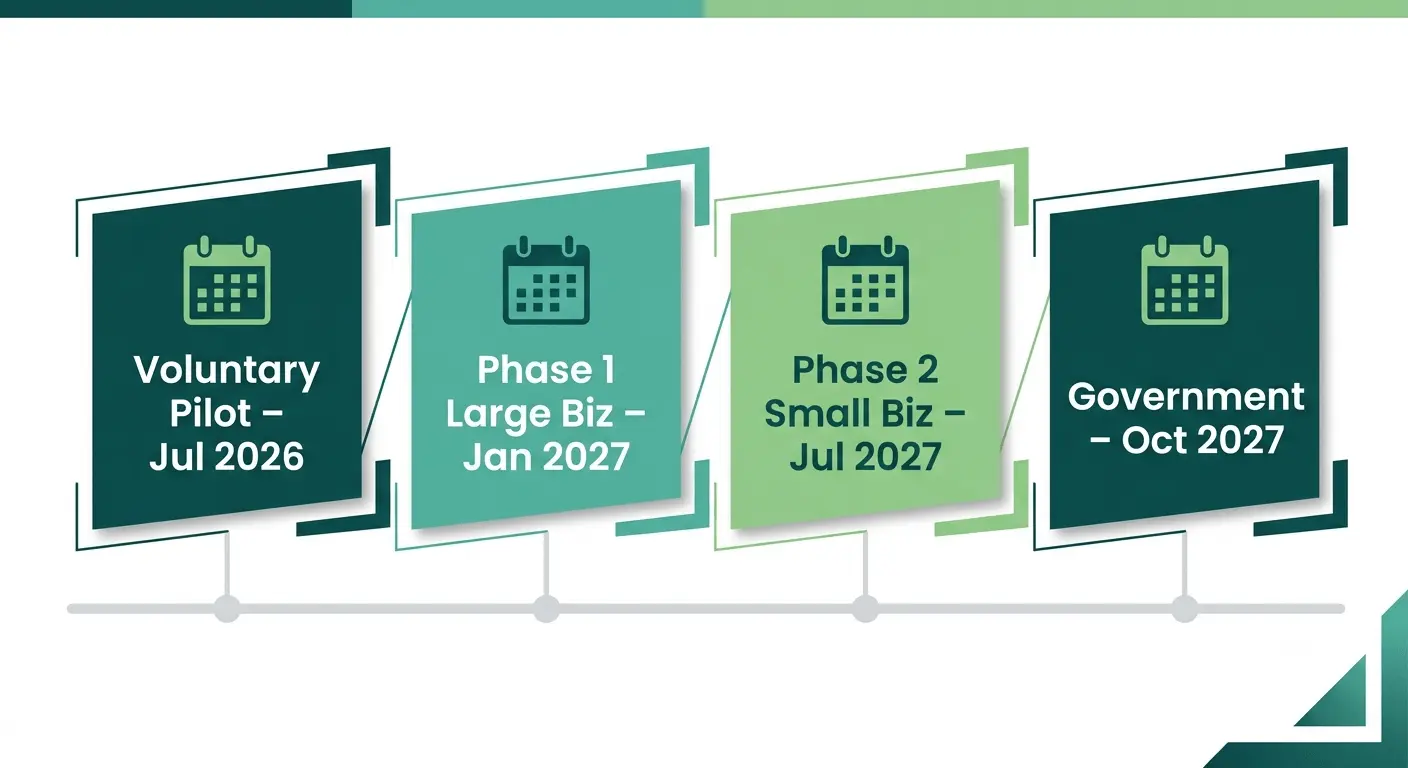
| Phase | Who It Applies To | ASP Appointment Deadline | Mandatory Go-Live |
|---|---|---|---|
| Voluntary pilot | Any business that opts in | Ongoing from 1 July 2026 | Optional |
| Phase 1 | Revenue of AED 50 million or more | Extended to 30 October 2026 | 1 January 2027 |
| Phase 2 | Revenue below AED 50 million | 31 March 2027 | 1 July 2027 |
| Government entities | Federal and local government bodies | 31 March 2027 | 1 October 2027 |
Even if you fall into Phase 2 as a smaller or newly formed business, the voluntary pilot starting 1 July 2026 gives you a penalty-free window to test your systems early. Businesses that wait until the deadline is close often struggle to find ERP integration support in time — early movers avoid that bottleneck.
What Do You Actually Need to Do to Prepare?
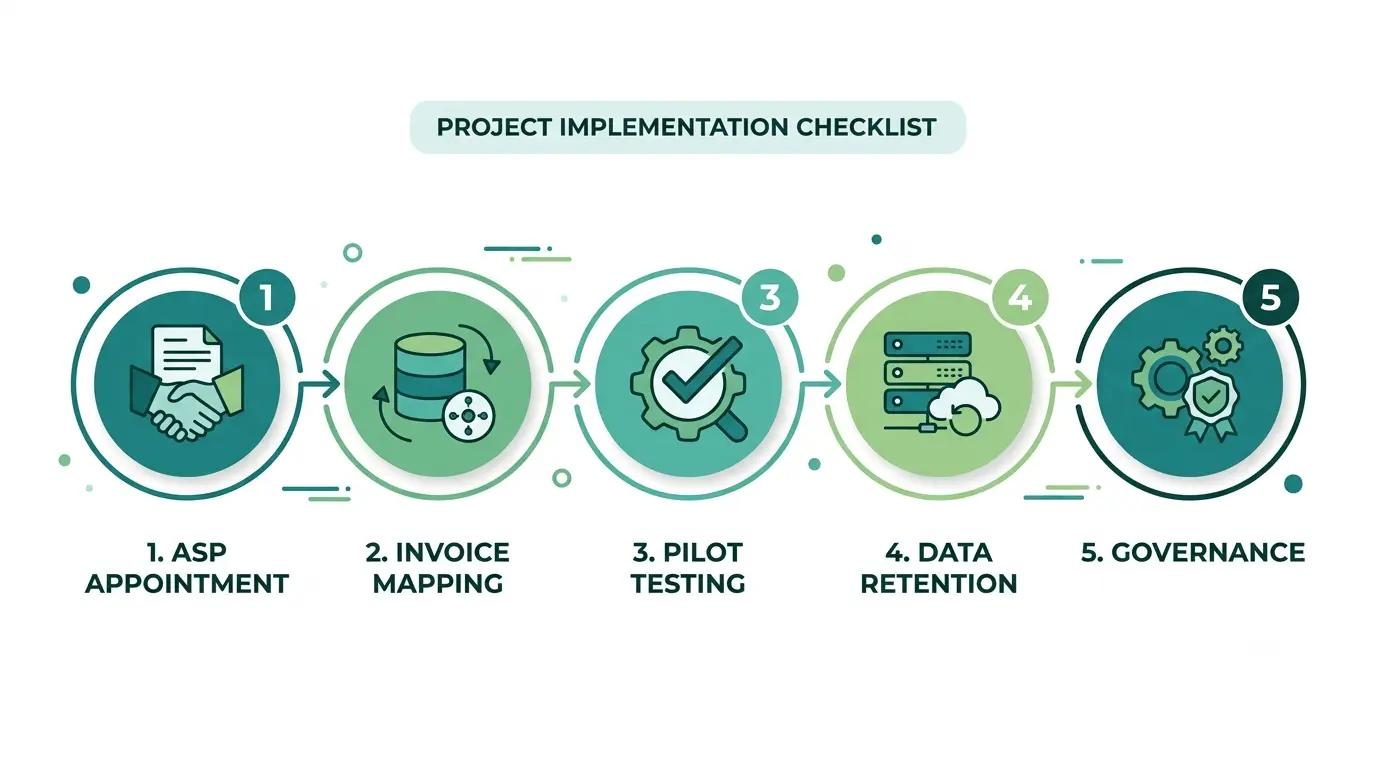
- Appoint an Accredited Service Provider (ASP). You cannot connect to the FTA's e-invoicing network directly — every invoice must pass through an MoF-approved ASP. The Ministry maintains a public register of pre-approved and accredited providers.
- Map your invoice data. Your ERP or accounting system needs to capture every mandatory field in the FTA's data dictionary — your Tax Registration Number, the buyer's Participant Identifier, VAT breakdown, and itemised tax details.
- Test before you are forced to. Use the voluntary pilot period to catch integration issues, rejected invoices, and data mapping errors while there is no compliance pressure.
- Plan for data storage. E-invoices must be securely archived and retrievable by the FTA for several years, so your storage setup needs to meet the retention requirement, not just the exchange requirement.
- Do not treat it as an IT-only project. ASP selection is a compliance decision as much as a technical one — the wrong fit means rejected invoices, delayed payments, and VAT reconciliation headaches down the line.
What Happens If You Miss the Deadline?
Quick answer: Non-compliance carries real financial exposure — missing an ASP appointment deadline can trigger recurring monthly fines, and issuing non-compliant invoice formats risks additional penalties under the UAE Tax Procedures Law.
For a new business still finding its feet, an avoidable compliance fine in year one is the kind of setback that is easy to prevent with the right setup from the start. If you are already registered for VAT and DED-related compliance, it is worth reviewing your invoicing workflow alongside your existing tax obligations rather than treating this as a separate project.
How This Fits Into Your Business Setup
At Tasreea, e-invoicing readiness is one more reason business setup should not be a DIY process. When we help you form your mainland, freezone, or offshore company in Abu Dhabi, we structure your business with the right VAT, banking, and compliance foundation from the outset — so changes like e-invoicing become a checklist item, not a scramble. Businesses already working with our digital and back-office services can also fold e-invoicing readiness into their existing system upgrades.
If you are already running a business and have not started preparing, it is not too late — but the sooner you start testing during the voluntary pilot phase, the smoother your transition will be.
Frequently Asked Questions
Is e-invoicing mandatory for all UAE businesses?
It will be, in phases. Large businesses (AED 50 million+ revenue) must comply from 1 January 2027, smaller businesses from 1 July 2027, and government entities from 1 October 2027. Voluntary adoption is open from 1 July 2026.
Can I use a PDF invoice instead of an e-invoice in the UAE?
No. Under the UAE Electronic Invoicing System, PDFs, scanned copies, and emailed invoices do not qualify as valid e-invoices, even if they contain correct VAT details.
What is an Accredited Service Provider (ASP) in UAE e-invoicing?
An ASP is a Ministry of Finance-approved intermediary that validates, formats, and transmits invoices between a business, its buyer, and the Federal Tax Authority. Businesses cannot connect to the FTA e-invoicing network directly.
Does UAE e-invoicing replace VAT return filing?
No. E-invoicing strengthens tax compliance and traceability, but VAT returns must still be filed separately with the Federal Tax Authority.
When should a new business in Abu Dhabi start preparing for e-invoicing?
As early as possible, ideally during the voluntary pilot phase starting 1 July 2026, so accounting and ERP systems are e-invoicing-ready before the mandatory compliance deadlines in 2027.
Need help getting your new business set up right the first time — VAT, banking, and compliance included? Contact Tasreea Business Center Services on WhatsApp at +971 50 368 9310 or visit our contact page for a free consultation.
Ready to get started?
Our Abu Dhabi consultants have helped 500+ entrepreneurs launch successfully. Book a free consultation and we will recommend the optimal solution for your specific business activity.
Get Your Free Consultation Today →WhatsApp us: +971 50 368 9310