
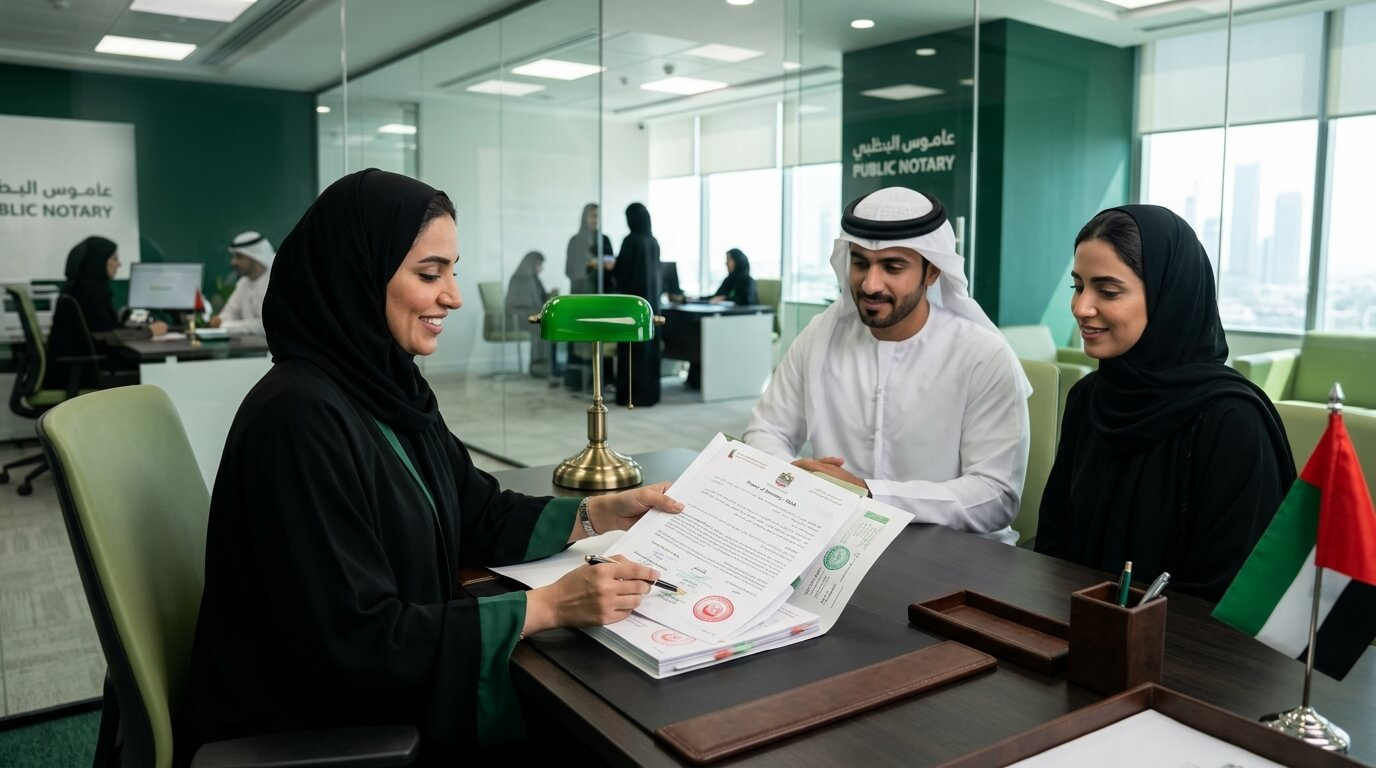
If you are registering a company in Abu Dhabi, finalising a property transaction, or signing a power of attorney, the Abu Dhabi Judicial Department (ADJD) notarization step is not optional — it is the legal foundation that makes your documents enforceable in the UAE.
Yet most business owners only discover the notarization requirement at the last minute, often after a bank or government portal rejects their submission. The delays that follow — re-drafting, reappointing a notary, rescheduling a visit — are almost always avoidable.
This guide covers exactly which documents require ADJD notarization in Abu Dhabi, how the process works step by step, what to prepare before you visit the notary, and where the most common delays happen. It is written from the perspective of a business setup consultancy in Mussafah M4 that coordinates notary public services for clients daily.
What Is Notary Public Attestation and Why Does It Matter in Abu Dhabi?
A notary public attestation is a legally binding verification carried out by a government-licensed notary officer. The notary confirms that the signatories are who they claim to be, that they are signing voluntarily, and that the document is authentic and complete.
In Abu Dhabi, notary public authority sits with the Abu Dhabi Judicial Department (ADJD), which operates licensed notary offices across the emirate — including several ADJD centres convenient to Mussafah-based businesses.
Without ADJD notarization, most corporate and legal documents in Abu Dhabi carry no legal weight. Banks will not open an account on an un-notarized MOA. The Department of Economic Development will not process a partnership change based on an un-notarized amendment. A power of attorney that has not been notarized by ADJD cannot be used to transfer property, sign contracts, or represent a company in government dealings.
ADJD notarization is not the same as MOFA attestation (which legalises documents for international use), and it is not the same as free zone notarization (which some zones offer internally). ADJD notary services are required for documents that must hold legal force within Abu Dhabi specifically.
ADJD vs Other Attestation Bodies: Notary Public vs MOFA vs Municipality
Confusion between different attestation authorities is one of the main reasons documents get rejected. Here is how ADJD notarization compares with the other common attestation channels in the UAE.
| Attestation Type | Authority | When Required | Scope | Typical Documents |
|---|---|---|---|---|
| ADJD Notary Public | Abu Dhabi Judicial Department | Domestic legal enforceability in Abu Dhabi | Abu Dhabi emirate only | MOA, AOA, powers of attorney, affidavits, property sale agreements |
| MOFA Attestation | Ministry of Foreign Affairs | International recognition / cross-emirate use | UAE-wide + international | Degree certificates, commercial invoices, foreign-issued documents |
| Municipality Attestation | Abu Dhabi City Municipality | Specific municipal compliance | Abu Dhabi only | Building contracts, tenancy addendums, certain trade name documents |
| Free Zone Notarization | Free zone authority (ADGM, KIZAD, etc.) | Internal free zone transactions | Within that free zone only | Board resolutions, share transfers, zone-issued documents |
| Embassy / Consulate Attestation | Foreign embassy in UAE | Document validation from country of origin | Country-specific | Birth certificates, degrees, criminal records from abroad |
The critical distinction: ADJD notarization is the only pathway for documents that must be legally enforceable within Abu Dhabi in courts, government portals, banks, and DED dealings. MOFA serves a different function — legalising documents for use outside the UAE or across emirates.
We handle this triage regularly at our Mussafah M4 centre: a client brings a board resolution and asks for MOFA attestation when what they actually need is ADJD notarization because the document is for a DED licence amendment. Getting the right authority the first time avoids the re-submission cycle. See also our breakdown of notarization vs attestation vs apostille for the wider documentation picture.
Which Documents Commonly Need ADJD Attestation in Abu Dhabi?
The ADJD notarization requirement applies to specific document categories. Here is a practical breakdown based on the documents we coordinate most frequently.
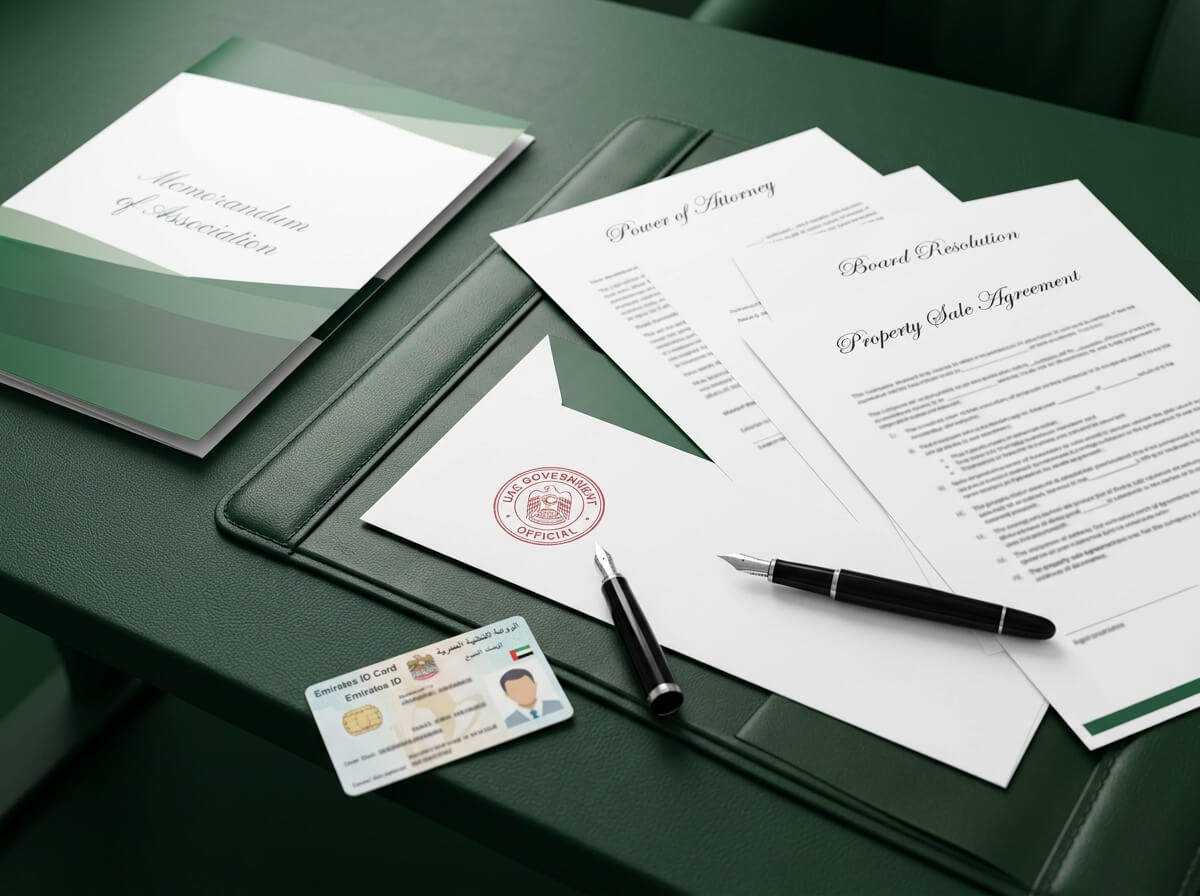
Business and Corporate Documents
Corporate documents that establish, modify, or dissolve a legal entity in Abu Dhabi almost always require ADJD notarization. These include board resolutions authorising specific actions (opening a bank account, appointing a signatory, entering a lease), partnership agreements, share transfer agreements for mainland companies, company closure or liquidation resolutions, and authorisation letters granting third parties power to act on behalf of the company.
Any time a government portal, bank, or government entity in Abu Dhabi asks for a "notarized resolution," they mean one stamped by an ADJD-licensed notary — not an internal company stamp.
Powers of Attorney
A power of attorney (POA) is one of the most commonly notarized documents in Abu Dhabi, and one of the most frequently rejected when the notarization step is missed or done incorrectly.
ADJD notarization applies to general powers of attorney (broad authority), special powers of attorney (limited to specific transactions), commercial powers of attorney (authorising a representative to deal with DED, banks, or government entities), and property powers of attorney (buying, selling, or managing real estate).
A power of attorney must be notarized while the grantor is physically present in the UAE, or via a properly executed notarial power from abroad that has been attested by the relevant UAE embassy and MOFA before ADJD notarization.
Memorandum of Association (MOA) and Articles of Association (AOA)
The MOA and AOA are the constitutional documents of any mainland company registered in Abu Dhabi. Every version — original, amendment, restated — requires ADJD notarization before it can be submitted to the Department of Economic Development.
Key scenarios where MOA/AOA notarization is triggered: new company formation (initial MOA execution), adding or removing partners (MOA amendment), changing company activity (AOA amendment), converting company type (for example, sole establishment to LLC), and increasing or decreasing share capital.
A common mistake we see: clients draft a MOA amendment, have it translated into Arabic, and submit it to ADDED without notarization. ADDED returns it immediately — the notarization must come first.
Personal Documents
Certain personal documents also require ADJD notarization in Abu Dhabi: affidavits (statutory declarations of fact), sponsorship letters (for employee or family visa sponsorship), no-objection certificates (NOC), and marriage or birth certificate declarations (when needed for family visa or school enrolment).
These are less frequent than corporate documents but equally time-sensitive — an un-notarized NOC for a visa application will delay the entire immigration process.
Property and Real Estate Documents
Property transactions in Abu Dhabi — whether personal or commercial — require ADJD notarization of sale and purchase agreements, property donation documents, lease assignments or sublease agreements, mortgage agreements, and tenancy contract amendments.
Abu Dhabi's real estate registration system (through the Department of Municipalities and Transport) will not register a transfer or mortgage without the underlying agreement being notarized by ADJD first.
Step-by-Step ADJD Notarization Process
The ADJD notarization process follows a defined sequence. Here is what it looks like in practice, based on the steps we coordinate for clients from our Mussafah M4 office.
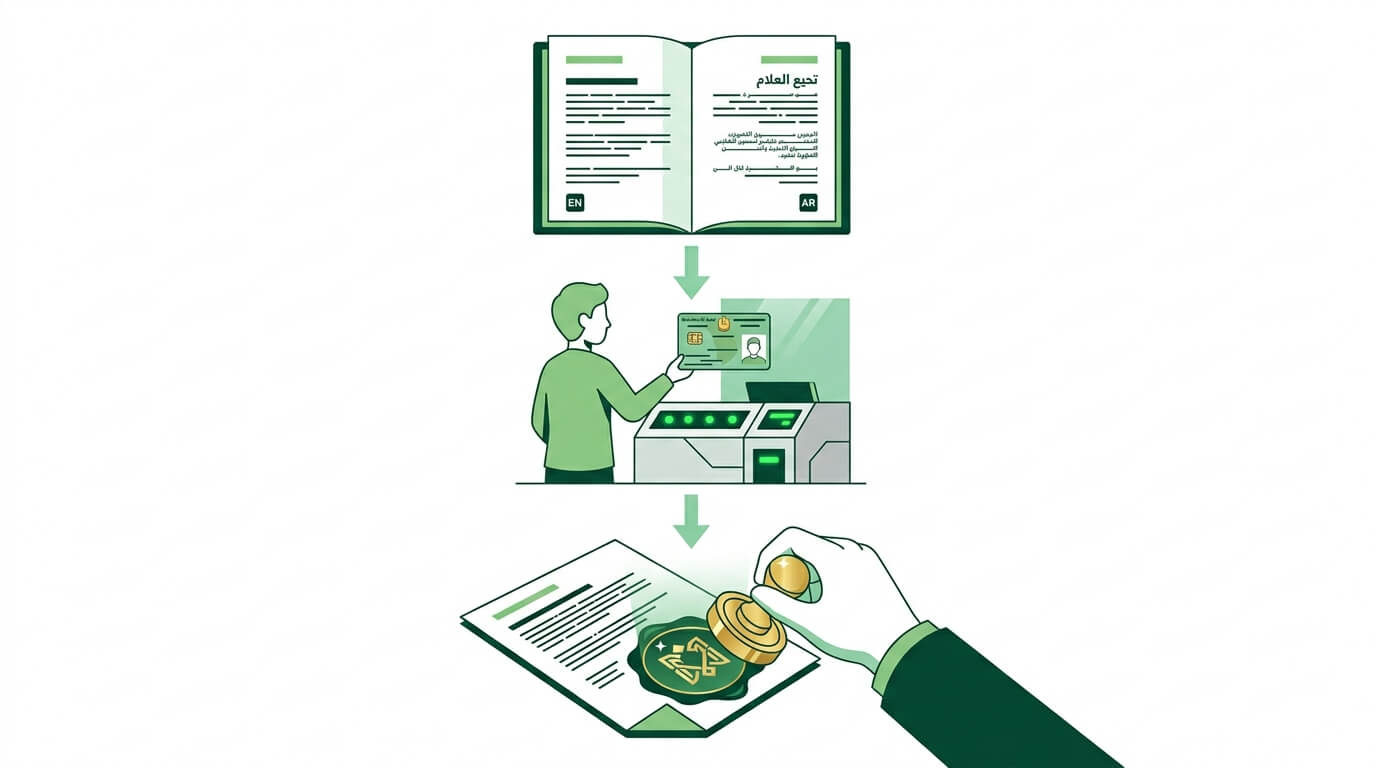
- Document preparation. Draft the document in its final form. Corporate documents must be on company letterhead (where applicable), signed by authorised signatories, and — if the signatory is not the company owner — accompanied by a board resolution or POA authorising the signatory.
- Arabic translation (if applicable). ADJD notaries in Abu Dhabi work in Arabic. If your document is in English only, it must be translated into Arabic by a UAE-licensed legal translator before notarization. The translation and the original must be presented together.
- Schedule the ADJD notary appointment. ADJD notary offices accept both walk-in and scheduled appointments. Walk-in queues, particularly at central Abu Dhabi ADJD branches, can be long. We recommend scheduling via the ADJD smart app or website to reduce wait times.
- Present documents and identification. The signatory must attend in person with the original document(s), the Arabic translation (if applicable), Emirates ID (for UAE residents) or passport (for visitors), the company trade licence (for corporate documents), and the board resolution or POA authorising the signatory (if not the owner).
- Notary review and signing. The ADJD notary officer reviews the document for completeness, verifies the identity and authority of the signatories, and witnesses the signing. The officer then stamps the document with the official ADJD notary seal.
- Collect the notarized document. The notarized document is returned to the applicant. Keep the original — ADJD and most government entities in Abu Dhabi require the original stamped copy, not a photocopy.
Documents and Requirements Checklist
Before heading to an ADJD notary office, run through this checklist:
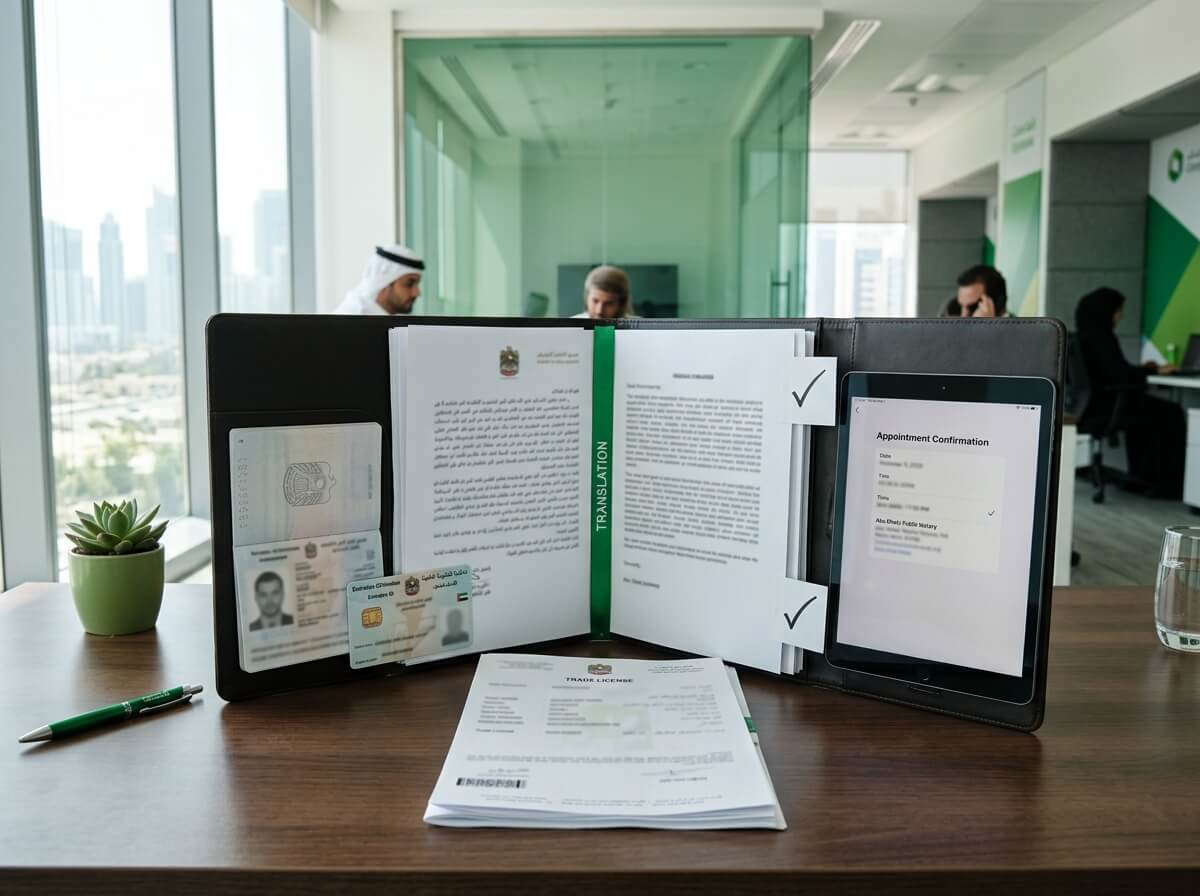
- Document prepared in final form (no blank fields, no unsigned sections)
- Arabic translation by a UAE-licensed translator (if the original is English or another language)
- Original document and translation presented together
- Emirates ID or passport for each signatory
- Valid trade licence (for corporate documents)
- Board resolution or POA authorising the signatory (if the signatory is not the company owner)
- Any supporting documents referenced in the main document
- Payment for ADJD notary fees (varies by document type — confirm the current schedule at the ADJD office or via the ADJD app)
Typical Timeline and Cost Range
Timeline: ADJD notarization itself is typically completed on the same day — most notary appointments take 30 to 60 minutes, and the stamped document is returned immediately. The bottleneck is document preparation and translation, which can take one to three business days depending on complexity and translator availability.
Cost range: ADJD notary fees vary by document type and value. As a general guide:
- Simple notarization of a single-page document (such as an affidavit or NOC): starting from approximately AED 100–250
- Corporate document notarization (MOA, board resolution): starting from approximately AED 200–500, depending on the number of pages and signatories
- Power of attorney notarization: starting from approximately AED 150–400, depending on the scope (general vs special)
These are government fees only. Legal translation, drafting assistance, and coordination services are additional. For current, confirmed fee schedules, contact us via WhatsApp — we verify the exact amount against the ADJD schedule before each appointment to avoid surprises.
Common Mistakes That Delay Attestation
Over thousands of ADJD notarizations coordinated from our Mussafah M4 centre, these are the errors that cause the most delays:
- Wrong authority selected.A client brings a document for "attestation" and goes to MOFA when they need ADJD, or vice versa. The document gets rejected, and the process starts again.
- Missing Arabic translation. ADJD notaries require Arabic. Submitting an English-only document without translation means an immediate trip back to a legal translator.
- Signatory authority not proven. If a manager (not the owner) signs a corporate document, ADJD requires a board resolution or POA proving they are authorised. Without it, the notary will not proceed.
- Unsigned or partially signed documents. The notary must witness the actual signing. Presenting an already-signed document means the notarization cannot proceed — the signatory must be present and sign in front of the notary.
- Expired identification. An expired Emirates ID or passport will not be accepted. Check expiry dates before the appointment.
- Incorrect document format. Documents that reference a different entity name, include blank fields, or contain crossing-out and corrections without initials may be rejected.
How Tasreea Handles Notary Public Coordination for Clients
At Tasreea Business Center, notary public coordination is a routine part of our business setup and PRO services. Our Mussafah M4 office is minutes from the nearest ADJD notary centre, and we coordinate the full process for clients — from document drafting and Arabic translation to ADJD appointment scheduling and attendance.
For clients setting up a new company in Abu Dhabi, we bundle notarization of the MOA, AOA, and any initial board resolutions into the formation package. For existing companies handling amendments, share transfers, or powers of attorney, we prepare the documents, confirm the Arabic translation, schedule the ADJD appointment, and handle any corrections required before the notary appointment. See our notary public services and notary public Abu Dhabi pages for full detail.
This means clients do not have to navigate the ADJD process themselves — we handle the requirements checklist, ensure documents are in the correct format before the appointment, and accompany clients where needed. If you need notary public services in Abu Dhabi — for a new company formation, a power of attorney, or a corporate amendment — reach out via WhatsApp to confirm the exact requirements, fees, and timeline for your specific document.
Frequently Asked Questions
How long does ADJD notarization take in Abu Dhabi?
The notarization appointment itself typically takes 30 to 60 minutes, and the stamped document is returned the same day. The overall timeline depends on document preparation and Arabic translation, which may take one to three business days before the notary appointment.
Can I notarize a document in Abu Dhabi if I live in another emirate?
Yes. ADJD notary services in Abu Dhabi are open to residents and businesses from any emirate. The document must relate to a transaction or entity registered in Abu Dhabi, or the notary must have jurisdiction over the subject matter. For documents tied to Dubai-registered entities, you would use the Dubai Courts notary instead.
Do I need an appointment for ADJD notary services?
ADJD notary offices accept both walk-ins and scheduled appointments. Walk-in wait times can be unpredictable, especially at central Abu Dhabi branches. We recommend scheduling through the ADJD smart app or website to reduce waiting.
What is the difference between notarization and attestation in the UAE?
Notarization (ADJD notary public) verifies the identity of signatories and the authenticity of the document for legal enforceability within Abu Dhabi. Attestation (MOFA) legalises a document for use outside the UAE or across emirates. They serve different purposes and are not interchangeable.
How much does ADJD notarization cost in Abu Dhabi?
ADJD notary fees vary by document type. Simple document notarization starts from approximately AED 100–250; corporate documents and powers of attorney start from approximately AED 150–500. Fees are subject to change — confirm the current schedule via the ADJD app or by contacting Tasreea before your appointment.
Can a power of attorney be notarized if the grantor is outside the UAE?
Yes, but the process is different. The grantor must have the POA attested by a UAE embassy in their country, then attested by MOFA in the UAE. After MOFA attestation, ADJD notarization can be completed in Abu Dhabi, often with the grantor's authorised representative present.
What happens if I submit an un-notarized document to ADDED or a bank?
Banks and ADDED (Department of Economic Development) in Abu Dhabi will reject documents that require ADJD notarization but have not been notarized. The document will be returned, and you will need to restart the notarization process — which means additional time, fees, and potential rescheduling.
Do I need an Arabic translation for ADJD notarization?
Yes. ADJD notaries in Abu Dhabi conduct business in Arabic. If your document is in English or any other language, a UAE-licensed legal translator must translate it into Arabic before the notary appointment. Both the original and the Arabic translation must be presented together.
Get Your Documents Notarized by ADJD — Without the Waiting
Confirm which document attestation authority applies to you, check the current ADJD fee, and schedule your notarization with one point of contact at our Mussafah M4 centre.
Or reach the Mussafah M4 team at +971 50 368 9310 or +971 02 552 3934, Sunday to Thursday.
Notary Public | PRO Services | Business Setup Abu Dhabi | Tasheel