

In 2026, foreigners can own 100% of most mainland companies in Abu Dhabi with no local partner, no mandatory Emirati sponsor, and full trading rights across the local market. This guide covers what changed, which activities now qualify, how mainland compares to a free zone, and what setup costs fromAED 11,000.
For years the practical barrier for expat entrepreneurs was the "local partner" requirement, which forced a partial ownership split. That barrier is gone for the majority of activities. If you are an expat founder, a foreign company expanding into Abu Dhabi, or a freelancer moving to a formal licence, the mainland is now a realistic first option — not a structure to avoid.
What Changed in 2026 for Mainland Ownership
The core change is that a foreign investor can now hold 100% ownership of a mainland Abu Dhabi company for most commercial, industrial, and professional activities, with no requirement for an Emirati local partner. The previous practical barrier of forced ownership sharing has been removed for the large majority of licensing activities.
This builds on changes that began years ago and were progressively expanded. What matters for 2026 is the scope: it is no longer limited to select "on-list" sectors. Mainland trading, manufacturing, and a broad set of service and professional activities are open to full foreign ownership. A small band of strategic activities — defence, security, certain oil and gas exploration, and restricted public-utility services — can still carry special licensing conditions, and these should always be checked for your specific activity code before you commit.
The practical reading for founders is simple: do not assume a local partner is required. Confirm your exact trade activity first, because the handful of restricted classifications are the exception rather than the rule.
Which Business Activities Now Qualify for 100% Ownership
Most commercial, industrial, and professional activities qualify for 100% foreign ownership on the Abu Dhabi mainland in 2026. The exceptions are a narrow list of strategic activities — such as certain defence, security, oil and gas exploration, and restricted public-utility services — which can remain subject to special conditions.
In practice, the following groups qualify as fully foreign-owned:
- Commercial and trading — import, export, distribution, retail, and general trading activities
- Industrial and manufacturing — production, processing, and packaging activities under an industrial licence
- Professional and consulting — consultancy, technology, media, marketing, and design services under a professional licence
- Freelance and trader schemes — individual-trade licences such as the Abu Dhabi Trader license, designed for single operators
The activity's classification matters more than the licence type. Before you pay for trade name reservation, ask whether your specific activity code sits on the restricted list. This is a short readiness check, not a legal hurdle, but it protects you from selecting a licence that does not match your model.
Mainland vs Freezone: Ownership Comparison
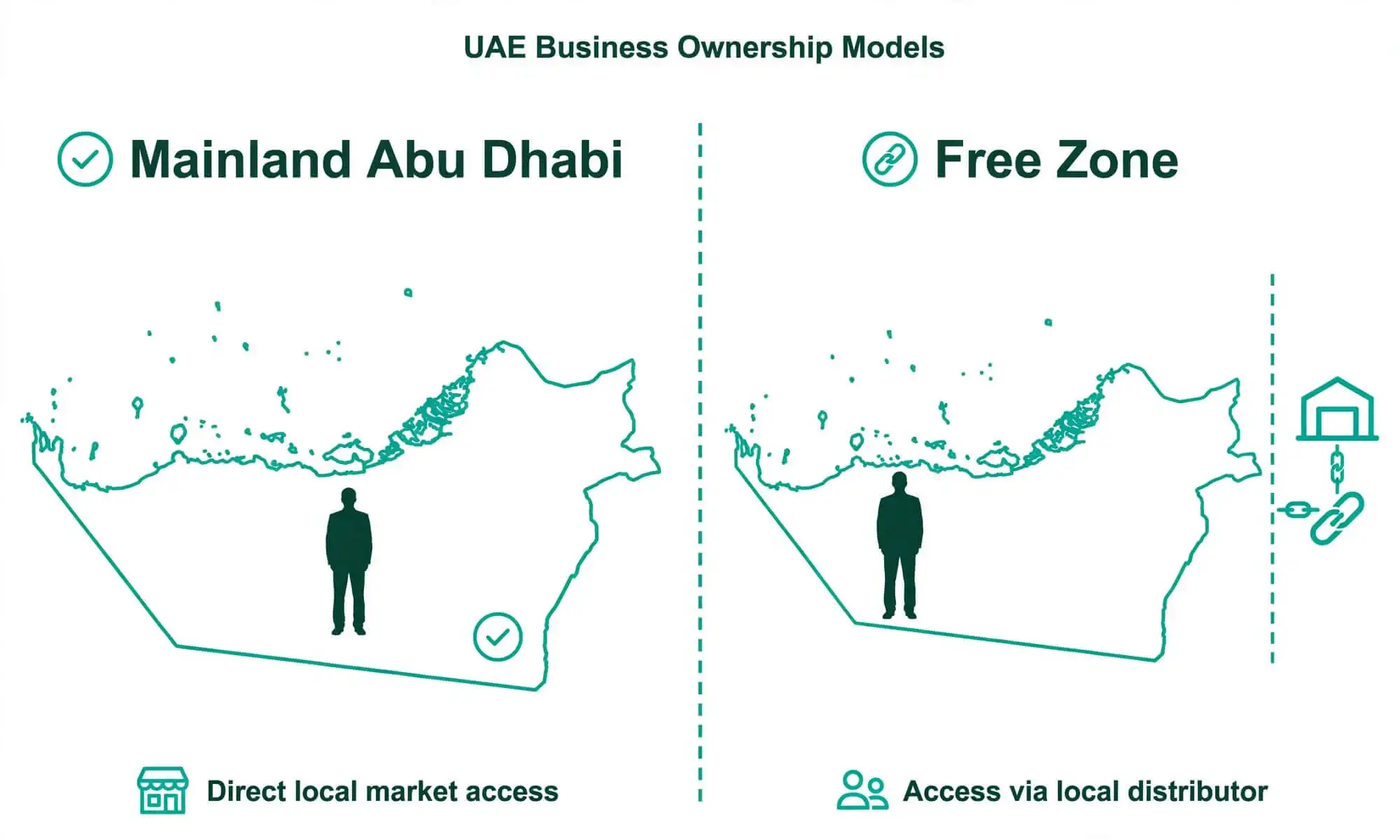
Both mainland and free zone structures allow 100% foreign ownership in 2026 — the real difference is where you are allowed to trade, not who owns the company. A mainland licence lets you sell directly across the Abu Dhabi market without a local distributor, while a free zone restricts onshore trading unless you appoint one.
| Factor | Mainland Abu Dhabi | Free Zone |
|---|---|---|
| Ownership | 100% for most activities | 100% |
| Local market trading | Direct access, no distributor needed | Restricted onshore; may need a local distributor |
| Registered address | Physical office or Tawtheeq virtual office | Free zone office or flexi-desk address |
| Employee visa quota | Scales with office space (typically larger) | Tied to desk/office package size |
| Government / corporate contracts | Eligible | Generally not eligible |
| Starting cost | From AED 11,000 | From AED 14,000 |
A useful rule: if your customers are local businesses, government, or retail customers in Abu Dhabi, the mainland licence is usually the better fit because it lets you invoice and distribute onshore directly. For exporters and international service firms that do not need the local market, a free zone can still be the tax-efficient choice. Neither blocks 100% ownership in 2026.
Who Should Choose Mainland Under the New Rules
Choose the Abu Dhabi mainland when selling to local customers, when you want direct onshore trading without a distributor, or when you need a larger employee visa quota. It suits three main profiles: expat entrepreneurs, foreign companies opening a local branch or subsidiary, and freelancers or consultants formalising a mainland presence.
Expat entrepreneur
If you live in the UAE and want a company under your own control — trading, retail, or services — a 100%-owned mainland Sole Establishment or LLC removes the old need to hand a stake to a local partner. You keep full decision-making and can invoice Abu Dhabi customers directly.
Foreign company expanding into Abu Dhabi
A foreign parent company can open a 100%-owned mainland branch or establish an Abu Dhabi subsidiary to serve local and federal government contracts, bid for corporate work, and hold a registered address in the capital. This is the structure most often chosen when local presence and government eligibility matter.
Freelancer or consultant formalising
If you are a solo consultant earning onshore, a mainland freelance or professional licence gives you a compliant way to invoice local clients without a managing partner and without the trading limits of a free zone. It also pairs cleanly with a registered virtual office when you do not need daily desk space.
Step-by-Step: How to Set Up a 100%-Owned Mainland Company in Abu Dhabi
A 100%-owned mainland company in Abu Dhabi is set up through a sequence of coordinated steps: confirm your activity, prepare your documents, work through the authority, and then handle visas. From the point your documents are complete, licence issuance for a standard Sole Establishment or LLC typically takes three to seven working days.
- Confirm your activity and structure — decide the trade activity and whether a Sole Establishment or LLC fits (one owner vs multiple shareholders)
- Reserve your trade name — check availability and guard the name before anything else
- Prepare documentation — passport copies, business details, and the activity-matched licence paperwork
- Set up your registered address — a physical office or a Tawtheeq-registered virtual office that satisfies the address requirement
- Licence issuance — the application is submitted and the trade licence is issued once approved
- Visas and banking — begin investor and employee visa processing and open a corporate bank account with your issued licence
Tasreea coordinates each of these stages and prepares the documentation; final approval and issuance rest with the relevant authority. The process moves in one continuous flow when the registered address is ready before you submit, rather than being sequenced behind an office lease — which is why many founders pair the licence with a virtual office at the start.
Costs Involved: How Much Does It Cost in 2026
A fully foreign-owned mainland company in Abu Dhabi starts from AED 11,000 for a single-owner Sole Establishment, covering the trade name, a matching licence activity, and your registered address. Additional shareholders, more activities, and larger visa quotas push the total higher.
Four line items typically make up the price:
- Trade name reservation and activity selection for the mainland
- Trade license for the chosen commercial, industrial, or professional activity
- Registered address — a physical lease or a Tawtheeq virtual office
- Visa and PRO coordination — investor and employee visas plus government liaison
Separate government charges apply for visas, Emirates ID, medical tests, and insurance — the same charges every company pays regardless of who coordinates setup. A transparent provider itemises everything before you commit. You can compare structured packages on the mainland business setup page or ask for a fixed itemised quote.
Real 2026 Price Signal
From AED 11,000 mainland is a realistic entry point for a single-owner Sole Establishment with trade name, licence, and address in place. In our experience with Mussafah-based setups, clients who already hold a passport copy and a clear activity in mind shorten the licensing window to the quieter end of the three-to-seven-working-day range. More activities, extra shareholders, and larger visa quotas push the total higher — ask for a fixed, itemised quote rather than a lump sum.
Important Note on Approval
This guide reflects the position for most wholly foreign-owned mainland activities in Abu Dhabi at the time of writing (September 2026). Final eligibility, licensing, and issuance always rest with the Department of Economic Development and the relevant licensing authority for your specific activity. Confirm restricted classifications for your exact activity code before committing, and note that requirements can change.
Internal eligibility guidance is one thing; a confirmed decision for your activity is another. If you have a specific activity in mind, run it past the team at Tasreea to verify the classification before you reserve anything.
Frequently Asked Questions
Can a foreigner own 100% of a mainland company in Abu Dhabi in 2026?
Yes. For most commercial, industrial, and professional activities in Abu Dhabi, a foreign investor can now hold 100% ownership of a mainland company without a local partner. There is no mandatory Emirati sponsor for the majority of license activities.
Which business activities in Abu Dhabi still require a local partner?
A small list of strategic and restricted sectors — such as certain defence, security, oil and gas exploration, and specific public-utility activities — can still carry special licensing conditions. For day-to-day trading, manufacturing, consulting, and most professional services, 100% foreign ownership applies.
What is the difference between mainland and free zone for a foreign owner?
The key difference is where you can trade. A mainland license in Abu Dhabi lets you sell directly across the local market without a local distributor and supports more employee visas. A free zone entity limits you to onshore trading unless you appoint a local distributor. Both structures allow 100% foreign ownership.
How much does a 100%-owned mainland company cost in Abu Dhabi?
Abu Dhabi mainland setup starts from AED 11,000 for a single-owner Sole Establishment, covering trade name, license activity, and registered address. Additional shareholders, extra activities, and larger visa quotas raise the final total.
Do I need a physical office for a mainland company in Abu Dhabi?
You need a registered office address, which can be a Tawtheeq-registered virtual office that supports one to three investor visas. If you need a bigger employee visa quota or daily workspace, a physical business centre lease is required instead.
How long does mainland company formation take in Abu Dhabi in 2026?
Once your documents are complete, trade license issuance for a standard Sole Establishment or LLC typically takes three to seven working days, before employer visa processing begins.
Ready to Own 100% of Your Mainland Company in Abu Dhabi?
Get a fixed, itemised quote for your activity — fully foreign-owned mainland setup from AED 11,000, with no hidden fees.
Or reach the Mussafah M4 team at +971 50 368 9310, Sunday to Thursday.