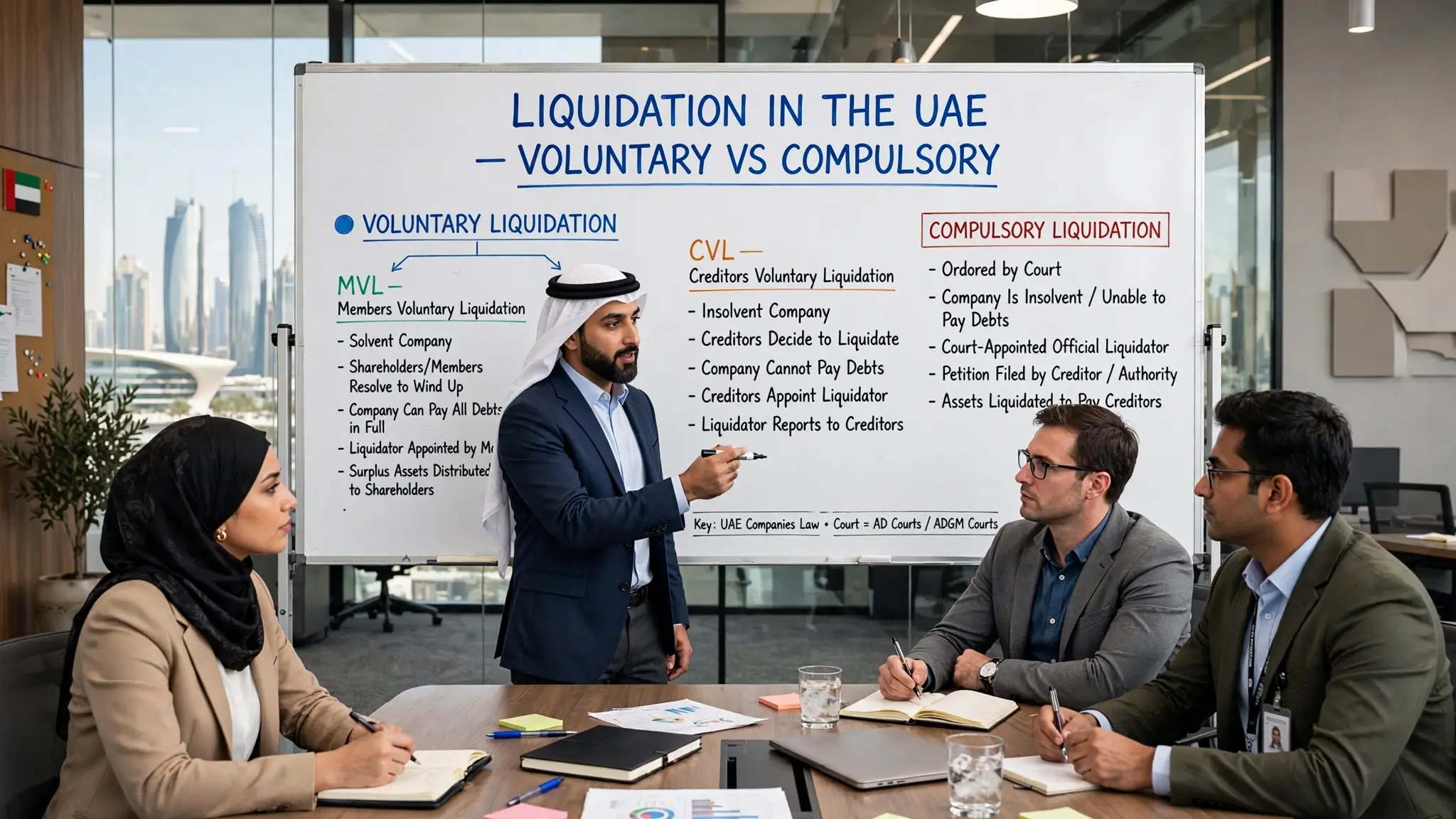
Liquidation is different from simply letting a license expire. It is the formal legal winding-up of a company under UAE Commercial Companies Law (Federal Decree-Law No. 32 of 2021) — appointing a liquidator (for LLCs and share-capital companies), settling any outstanding debts, cancelling employee visas and labor cards, and closing government, utility, and bank accounts — before the Department of Economic Development (ADDED) issues a final License Cancellation Certificate.
Skipping this process, or letting a license lapse instead, leaves the owner exposed to renewal penalties, MOHRE fines, immigration blacklisting, and frozen bank accounts that can follow the business owner long after the company stops operating.
A licensed liquidator is mandatory. The liquidator manages creditor notices, prepares the liquidation reports, and confirms there are no outstanding claims before the license can be cancelled.
No liquidator is required. The owner (or an authorized representative) can apply directly through TAMM/ADDED once MOHRE and ICP clearances are in place. This route is significantly faster.
Shareholder Resolution — A notarized resolution approving liquidation and appointing a licensed liquidator (LLCs only)
Liquidator Acceptance — The liquidator submits their acceptance letter, license copy, and auditor registration certificate
Initial Filing with ADDED — Submitted via TAMM using UAE PASS, with the trade license, MOA, and resolution
Newspaper Publication — The liquidation notice is published in two local newspapers (one in Arabic), opening a mandatory 45-day creditor objection period
Employee & Visa Clearance — All labor cards and employee visas are cancelled through MOHRE
Establishment Card Cancellation — Cancelled with ICP (Federal Authority for Identity, Citizenship, Customs & Port Security)
Utility, Bank & Tax Closure — ADDC and telecom accounts settled, corporate bank account closed, and VAT deregistration completed with the FTA
Final Liquidator Report — Submitted to ADDED once the 45-day period passes with no creditor objections
License Cancellation Certificate — Issued by ADDED once all fees are paid and clearances confirmed

Sole establishment: typically a few weeks, since it skips the liquidator and creditor notice period entirely.
LLC / share-capital company: typically 60–90 days — the 45-day creditor notice period alone does not start until the liquidator's documents are accepted.
Government fees (approximate, paid to ADDED/Chamber): Chamber fee, license cancellation fee, liquidation fee, and newspaper advertisement fee — liquidator professional fees, notarization, and any outstanding penalties are separate.
Note: government fee amounts and processing times change periodically — Tasreea confirms current figures at the time of application.
Letting a license lapse instead of formally liquidating exposes the business owner to accumulating renewal penalties (ADDED adds late fees yearly), MOHRE fines for outstanding labour obligations, ICP immigration blocks on the sponsor's passport, blacklisting that prevents future directorship or visa sponsorship in the UAE, frozen corporate bank accounts, and potential liability for unpaid utility or telecom contracts. These consequences can persist years after the company stops trading.
End-to-end handling: liquidator coordination, ADDED/TAMM filing, MOHRE & ICP clearances
One point of contact instead of juggling multiple government departments
Clear timeline set upfront so you are not paying rent, salaries, or utilities longer than necessary
Same team that handled your company formation can also handle its closure
Ready to close your company the right way? WhatsApp us at +971 50 368 9310
Book a Free Consultation →License cancellation is the final administrative step. Liquidation is the full legal process — settling debts, notifying creditors, and appointing a liquidator — that LLCs must complete before the license can be cancelled.
Sole establishments can close in a few weeks. LLCs typically take 60–90 days, mainly due to the mandatory 45-day creditor notice period.
No. Only LLCs and companies with share capital are legally required to appoint a licensed liquidator.
Members' Voluntary Liquidation (MVL) is for solvent companies whose shareholders can pay all debts within 12 months — they issue a Declaration of Solvency and the shareholders appoint the liquidator. Creditors' Voluntary Liquidation (CVL) is for companies that cannot pay their debts — a creditors' meeting follows the shareholder resolution, and the creditors appoint the liquidator.
Some Abu Dhabi free zones do not require newspaper publication. Instead, they may post the liquidation notice on an internal notice board or their official website. Rules vary per free zone — check with your specific free zone authority or let Tasreea confirm the requirements for you.
Unpaid renewal fees turn into penalties, MOHRE can flag unresolved labor obligations, ICP can block future visa applications, and outstanding utility or bank liabilities can follow the owner even after the business stops running.
Yes — Tasreea coordinates with a licensed liquidator as part of the end-to-end service, alongside all government filings and clearances, for both mainland ADDED companies and Abu Dhabi free zone entities.
Looking to start a new venture instead? Explore our Business Setup, Tajer Abu Dhabi or contact us for a free consultation.